Identity is the New Firewall: Cybersecurity in the Age of Deepfakes

19
Jan
Identity is the New Firewall: Cybersecurity in the Age of Deepfakes
For decades, cybersecurity was about building higher walls around your data centers. It was about firewalls, VPNs, and network perimeters. If you were “inside” the network, you were trusted.
In 2026, the network perimeter is gone. Your applications live in the cloud, and your users are everywhere. The only perimeter left is identity—knowing that the person holding the phone is truly who they say they are.
But here is the terrifying part of our new reality: in the age of generative AI, “seeing” is no longer “believing.”
If your mobile app’s security relies on a password and an SMS code, you are bringing a knife to a nuclear gunfight. The threats have evolved, and your security architecture needs to evolve with them.
The Rise of the “Synthetic Identity” Attack
We used to worry about hackers stealing databases of passwords. Now, we have to worry about hackers stealing faces and voices.
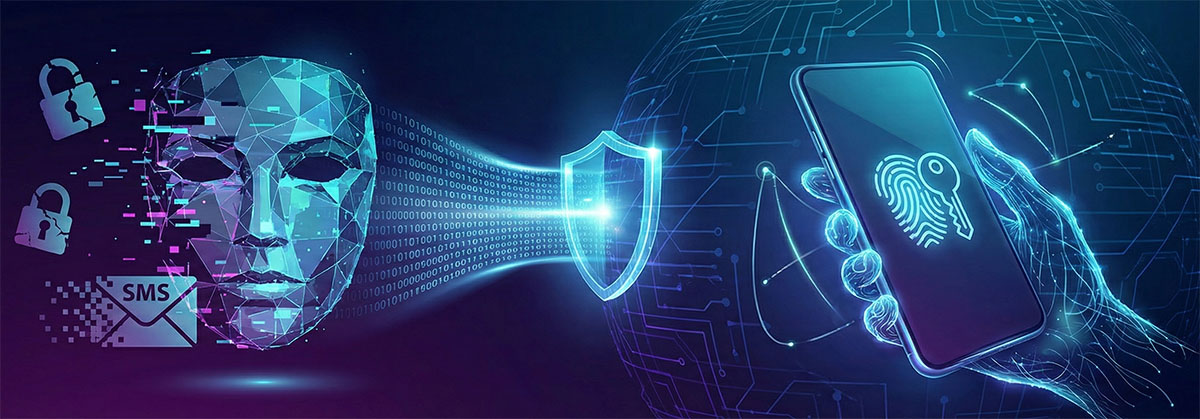
AI tools have become frighteningly good at creating deepfakes in real-time. We are seeing sophisticated social engineering attacks where a fraudster uses a real-time voice clone of a CEO to authorize a wire transfer, or a live deepfake video feed to bypass the “liveness check” in a banking app’s onboarding flow.
This isn’t just a theoretical threat for three-letter agencies anymore; it’s a scalable attack vector targeting fintech, healthcare, and enterprise apps right now. If an AI can convince your app’s camera that it’s your customer, your entire security model collapses.
Why SMS 2FA is Now a Liability
For years, we told everyone to turn on Two-Factor Authentication (2FA), and for most, that meant getting a six-digit code via SMS.
In 2026, relying on SMS for security is borderline negligent.
SIM-swapping attacks—where a hacker bribes a telecom employee to port your number to their phone—are automated and cheap. Furthermore, SMS messages are unencrypted and easily intercepted. When a hacker can steal your password and intercept your 2FA code, that “second factor” is nothing more than false security theater. It slows down legitimate users while barely inconveniencing sophisticated attackers.
The New Standard: Passkeys and Behavior
So, how do you prove identity when physical appearance can be faked? You move to methods that are cryptography-based and behavior-based.
1. The End of Passwords: Enter Passkeys The industry is finally coalescing around Passkeys (based on FIDO2 standards). A passkey is a cryptographic key pair. The public key sits on your server, and the private key lives securely on the user’s device, unlocked only by their local biometric (FaceID/fingerprint).
- Why it wins: There is no password to steal, phish, or guess. Even if a hacker creates a perfect deepfake of a user, they can’t authenticate without physical possession of that user’s unlocked phone. It’s un-phishable by design.
2. The “Un-Fakeable” Metric: Behavioral Biometrics This is the frontier of mobile security. While an AI can fake a face, it cannot fake the unique, subconscious ways a human interacts with a device.
Behavioral biometrics analyze thousands of data points in the background:
- The angle at which you hold your phone.
- The pressure you apply to the screen.
- Your unique typing cadence and rhythm.
- The speed of your swipe gestures.
An AI bot doesn’t have hands; it doesn’t “hold” a phone. By building a behavioral profile of a legitimate user, your app can detect an anomaly instantly. If the typing speed suddenly changes or the device Gyroscope data doesn’t match human movement, the app can silently step up security or block the session—even if the credentials are correct.
The Verdict
In 2026, “Zero Trust” means assuming that every login attempt is potentially hostile until proven otherwise by irrefutable, cryptographic evidence.
Moving away from passwords and SMS isn’t just about improving security; it’s about improving the user experience. Passkeys are faster and easier than remembering complex passwords.
Your users deserve an app that is both effortless to use and impossible to breach. It’s time to retire the legacy security models and build for the reality of the AI age.



Leave a Comment