Edge AI: Bringing Intelligence “On-Device” for Privacy and Speed

19
Jan
Edge AI: Bringing Intelligence “On-Device” for Privacy and Speed
For the last decade, the mantra of software development was simple: “Move it to the cloud.” We treated mobile phones as dumb screens and relied on massive server farms to do all the heavy lifting.
But in 2026, the pendulum is swinging back.
We have reached a tipping point where the “cloud-first” default is becoming a liability. Cloud inference costs are skyrocketing, and users are becoming increasingly paranoid about where their data goes.
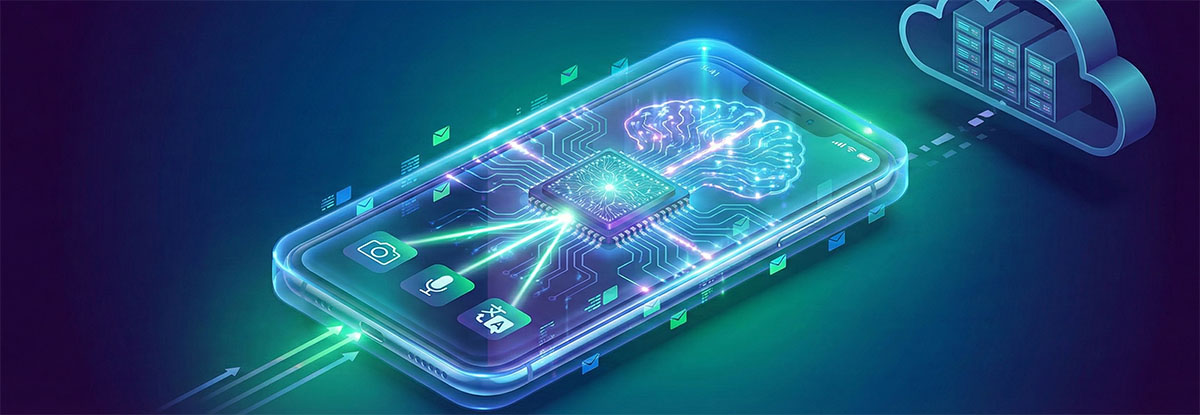
The solution isn’t bigger servers; it’s smarter phones. Welcome to the age of Edge AI—running powerful, efficient AI models directly on your user’s device, right in the palm of their hand.
Here is why your next mobile architecture should keep the intelligence local.
1. Privacy by Physics, Not Promises
In the era of GDPR, CCPA, and AI regulation, handling user data is a legal minefield. When you process data in the cloud, you have to encrypt it, transmit it, store it, and secure it. You are constantly asking users to “trust” you.
Edge AI changes the game because the data never leaves the device.
Imagine a mental health journaling app.
- The Cloud Way: The user types their deepest secrets, and that text is sent across the internet to an OpenAI or Google server to be analyzed. Even with encryption, that’s a vulnerability.
- The Edge Way: A Small Language Model (SLM) running locally on the phone analyzes the text. The insight is generated instantly, and the raw data is deleted without ever touching a WiFi signal.
For HealthTech and FinTech, this is the Holy Grail. You aren’t just promising privacy; you are guaranteeing it by the laws of physics. The data literally cannot be intercepted because it never traveled.
2. Zero Latency: The “Instant” Factor
We have all experienced the “AI pause”—that annoying 3-second spinning wheel while a chatbot thinks. In a world of instant gratification, 3 seconds is an eternity.
When you rely on the cloud, you are at the mercy of network latency. If the user is in a subway tunnel, a basement, or a crowded stadium, your “smart” app becomes dumb.
On-device AI offers zero latency. Because the brain is on the phone, the response is instantaneous.
- Real-time voice translation happens as you speak, not after you pause.
- Image recognition in an augmented reality (AR) shopping app happens instantly as the camera moves.
It creates a buttery-smooth user experience that cloud-tethered apps simply cannot match.
3. The Economics: Stop Burning Cash on Cloud Bills
Here is the dirty secret of the AI boom: Inference costs are eating margins alive.
Every time a user asks your cloud-based AI a question, it costs you money in compute power. If your app goes viral, your AWS or Azure bill creates a “success disaster” where costs scale linearly with users.
Edge AI offloads that cost to the user.
Modern smartphones in 2026 are equipped with incredibly powerful NPUs (Neural Processing Units). They are mini supercomputers. By running a compressed AI model on the user’s hardware, you are utilizing computing power they have already paid for.
You get the scalability of a software product with the marginal cost of a traditional app, rather than the heavy recurring cost of a SaaS platform.
The Verdict
The cloud will always have a place for training massive models and storing long-term data. But for the moment-to-moment intelligence that powers your mobile app? The future is local.
It’s faster, it’s private, and it stops the bleeding on your monthly server invoices. If you aren’t optimizing your AI for the Edge, you are paying too much for a slower product.



Leave a Comment