The Era of “Agentic AI”: Moving From Chatbots to Action

19
Jan
The Era of “Agentic AI”: Moving From Chatbots to Action
Remember 2024? That was the year we all marveled at AI that could write poetry, generate logos, and summarize emails. It was the era of Generative AI—and it was impressive.
But let’s be honest: while a poem about your supply chain is fun, it doesn’t actually fix your supply chain.
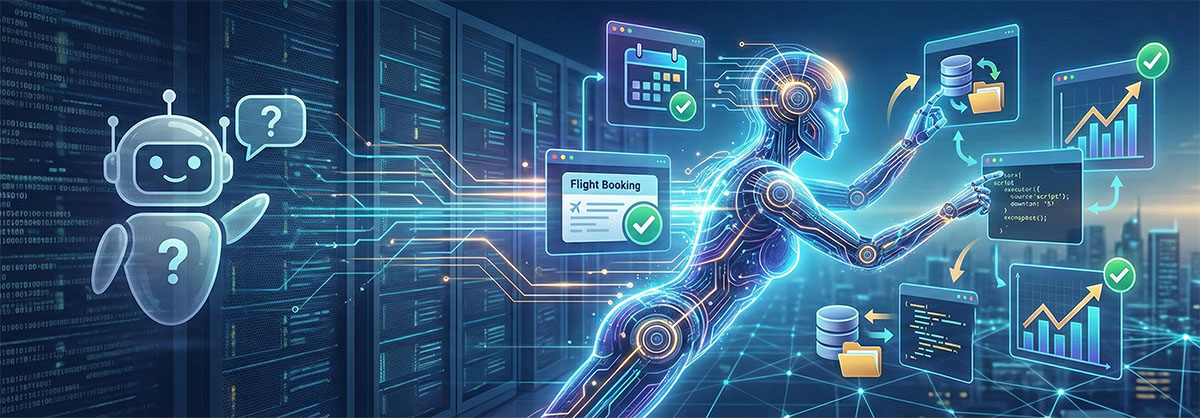
Welcome to 2026. The novelty of “chatting” with software has worn off. We are now entering the era of Agentic AI. The buzzwords have shifted from “generation” to “execution.” The question is no longer “What can this AI say?” but rather, “What can this AI do?”
If your mobile app roadmap for this year is still focused on chatbots, you might be solving yesterday’s problem. Here is why the next generation of apps needs agents, not just assistants.
The Difference: The “Writer” vs. The “Doer”
To understand the shift, think of Generative AI (like the early versions of ChatGPT) as a talented writer. You give it a prompt, and it gives you text. It’s passive. It waits for you.
Agentic AI is different. Think of it as a project manager. It doesn’t just wait for a prompt; it has permission to use “tools” (APIs, databases, software interfaces) to achieve a goal.
- Generative AI tells you how to reset a password.
- Agentic AI logs into the admin panel, verifies the user’s biometrics, resets the password, emails them the temporary credential, and updates the security log—all without a human lifting a finger.
For mobile app developers, this is a massive paradigm shift. We aren’t just building interfaces for users to tap buttons anymore; we are building interfaces for AI agents to press those buttons for us.
Beyond “I’m Sorry, I Didn’t Catch That”
We have all been trapped in the loop of a bad customer support chatbot. It apologizes profusely but eventually forces you to wait for a human agent because it lacks the authority to actually help you.
Agentic AI changes this dynamic completely by automating Tier 1 and Tier 2 support workflows.
Imagine a banking app where a user says, “I was double-charged for my coffee.”
- The Old Way: The bot gives a generic response about dispute policies and opens a ticket.
- The Agentic Way: The AI agent checks the transaction history, identifies the duplicate timestamp, verifies it falls within the “instant refund” threshold, communicates with the payment gateway to reverse the charge, and sends a push notification: “I’ve reversed the duplicate charge of $4.50. It should appear in your account within 24 hours.”
This isn’t sci-fi; it’s simply connecting the AI model to your backend APIs. The result? happier customers and a support team that only deals with complex, high-value issues.
Breathing New Life into Legacy Systems
Here is the secret weapon of Agentic AI: It plays nice with the old stuff.
Many enterprises are stuck with “Legacy Spaghetti”—older software that is critical to the business but doesn’t have modern APIs. Rewriting it all from scratch is too expensive and risky.
Agentic AI can act as a bridge. With modern computer vision and screen-reading capabilities, AI agents can actually “use” legacy desktop software just like a human would—clicking menus and typing into fields—but at lightning speed.
This means you can build a sleek, modern mobile app for your field workforce that feels cutting-edge, while in the background, an AI agent is doing the dirty work of updating the 15-year-old ERP system back at HQ. You get digital transformation without the “rip and replace” nightmare.
The Next Step
The shift to Agentic AI isn’t just a technical upgrade; it’s a competitive advantage. Users will gravitate toward apps that do the work for them, not apps that just give them more to read.
Does your current mobile strategy rely on passive bots or active agents?
If you are ready to explore how custom AI agents can automate your specific business workflows—and integrate safely with the software you already have—let’s talk. We can build a Proof of Concept (POC) in weeks, not months, to show you exactly what “doing” looks like.



Leave a Comment